The summer before my senior year of high school I interned at the Georgia Tech Research Institute through STEM@GTRI, and I wanted to build something a teacher would actually use. Taking attendance eats the first few minutes of every class, so: a camera that does it for you.
How it works
Enrolling a student. A setup script opens the webcam and takes 75 photos of your face. Each one is converted to grayscale and shrunk, which throws away detail the recognizer doesn’t need and makes matching faster.

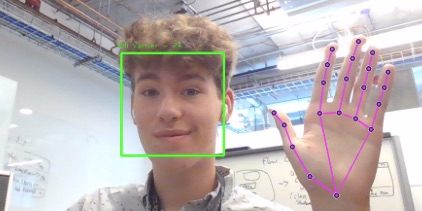
Recognizing faces. On every frame, a Haar cascade (OpenCV’s classic fast face finder) draws a box around each face. The box gets handed to an LBPH recognizer, which compares the texture of that face to everyone it was trained on. If it’s confident enough, you’re checked in; if not, it says unknown instead of guessing.
Keeping the record. Each day gets its own MySQL table: who arrived, when, and when they left. A small Flask site behind a login shows the day’s attendance and the student list, so a teacher never has to open a database tool.
Raised hands. This part was built with Zoom in mind: in a big online class, a teacher can’t watch forty little video tiles for a hand going up. Google’s MediaPipe tracks hands in the same video feed, and TechDetect matches a raised hand to the face next to it, so it knows who has a question. That mattered more to me than attendance did.
What came of it
TechDetect won the 2022 Congressional App Challenge for Georgia’s 5th district, and I got to meet Rep. Nikema Williams. It was the first thing I built that worked end to end and that other people cared about.
Looking back
The code is very high school. If I built it today I’d swap LBPH for modern face embeddings, use parameterized SQL instead of building queries out of strings, and think a lot harder about consent before pointing a camera at a classroom. (An early version also tried to tell whether you were paying attention. I cut it, which was the right call.) But the instinct was right: find a small, annoying, everyday problem and make it go away.