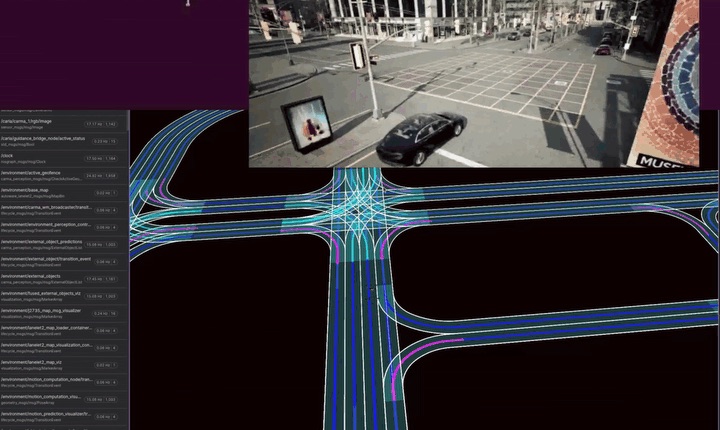
CARMA is the U.S. Department of Transportation’s open-source platform for cooperative driving: cars that coordinate with each other and with traffic lights. CARLA is an open-source driving simulator. Hooking them together means you can test CARMA’s driving logic in a realistic simulated city instead of on a real road.
I worked on that connection for Leidos, through UGA’s Mobility Systems Control Lab, from May 2025 to January 2026.
What I did
- ROS 1 → ROS 2. Ported 15+ bridge nodes to ROS 2 (the robotics framework both sides speak): new build system, launch files rewritten in Python, every node moved onto the ROS 2 client libraries.
- A new bridge. CARLA 0.10 dropped the piece that used to tell ROS where the car and its sensors are. I wrote a Python/C++ bridge that publishes those transforms (map → vehicle → each sensor), which CARMA needs before it can localize or plan a route. It cut out the old middleware, and the two sides now talk directly with under 5 ms of latency.
- Making the car actually drive. Once everything was connected, the car still wouldn’t follow its route. Two causes: the steering controller needed retuning, and CARLA (built on Unreal) uses a left-handed coordinate system while ROS uses a right-handed one, so some directions were quietly mirrored.
What I took from it
Most of the work was in the seams between systems: two frameworks, two coordinate conventions, one car that wouldn’t turn. That’s also where I got interested in testing driving stacks at scale, which became my current research.