Switch games were made for a tablet chip from 2015. Run one natively on an M-series Mac and the GPU is barely awake: 4K at 60 fps is easy. It still looks like a Switch game, though: milky colors, soft shadows, almost no ambient occlusion, 512px textures on every wall. Upscalers can’t fix that. They make sharper pixels, but they don’t add light that was never rendered. Sharper mud is still mud.
NXRemix goes after the ingredients instead. Agents read the game’s own shaders, rewrite the lighting, color and shadows, rebuild its textures, and check every change against the exact same frame. What you share at the end is a recipe: shader diffs, rules and prompts, a few kilobytes, with no game files in it.
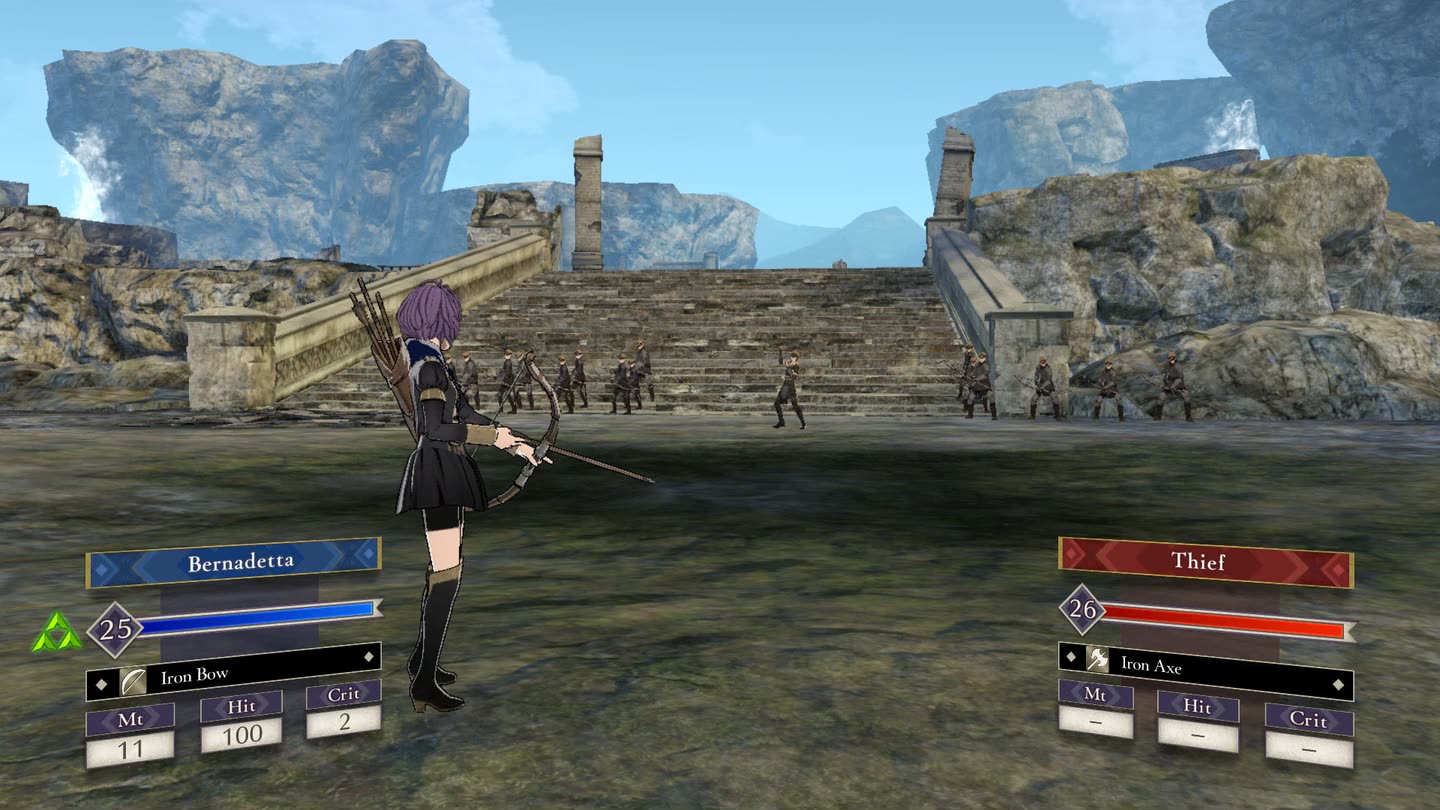 stock · via nxnativetarget · mockup
That’s the honest status: it’s early, but moving fast. Phase 0 (rebuild a shader, change it live) is done, and the pieces of Phase 1 are built and tested: native 4K that gets past the title screen, a map of every shader in the game, lighting modules ready to drop in, a texture factory and an automatic critic. What isn’t done yet is putting them together on a real save. So the right side of every slider on this page is still a mockup, and I’ll swap in real captures as they land.
Standing on nxnative
None of this works without nxnative. It’s seedds’ project, not mine (I contribute to it). It turns a Switch game you own into a native Apple Silicon app, and it translates every one of the game’s shaders into readable Metal Shading Language ahead of time.
That second part is the opening. The renderer stops being a black box and becomes source code an agent can read, reason about and rewrite: find the tonemap pass, swap in a filmic curve, add contact shadows from the depth buffer, give the cel shader a rim light. Then render the same frame again and prove it got better.
How it works
It’s one loop:
- Run. nxnative runs the game natively on Metal. My runner starts the game directly and points every writable path, saves included, at a throwaway folder. It refuses to write anywhere near the real save folder, which matters, because WarpPoint syncs those saves with my Switch.
- Read. nxnative can dump every render pass of a frame. From that you get the frame graph: which pass draws the world, which one tonemaps, where the UI starts.
- Rewrite. Agents edit the translated shaders by key and rebuild only those, through nxnative’s own build steps. Edits are pattern rules, not hand patches, so one rule covers every variant of a shader.
- Judge. The same frame, stock and changed: a pixel diff for the UI, which must not move, and a vision model for questions like “did the faces survive”.
- Recipe. Whatever passes gets written down as diffs, rules and prompts. You apply it to your own copy of the game.
Why not put a real-time AI filter over the frame instead? Because those boil from frame to frame, change faces and melt UI text. NXRemix does the AI work once, offline, and then the game runs on plain, deterministic Metal at full frame rate.
Phase 0: one shader, changed for real
The first milestone was small on purpose: change one shader in Fire Emblem: Three Houses (FE3H) and show the same scene before and after.
Prove the rebuild is clean. Before changing anything, I rebuilt an untouched shader through nxnative’s own build steps and checked that it came out byte-identical to stock. Screenshots would have been a noisy test (the fire in the scene animates); identical compiled shaders mean identical rendering, no squinting required.
Find the tonemap. I dumped one frame pass by pass: the lighting buffers, the HDR scene, the auto-exposure chain that shrinks the image to a single pixel, the bloom. The first pass that draws into the final image is FE3H’s tonemap. Everything after it is UI, which is exactly the line the pixel diff guards.
Change it, and measure. A small patcher routes the shader’s color output through a grade. The recipe holds only that snippet, never the game’s code. My first grade came out too dark (average brightness 96 → 78), and measuring showed why: the curve was bending linear light, before the frame gets encoded for the screen. Redone in display space, brightness held (96.9 → 94.4) with a bit more contrast, as the offline model predicted.
Live reload. Restarting the game for every edit is slow, so I added a reload command to nxnative: about 60 lines that swap a rebuilt shader into the running game in 0.6 to 1.1 ms. Before and after now show up in the same run. It’s on a local branch for now.
The target
The battle up top is one of three scenes I picked, each with a different problem. Here are the other two. Same deal: one frame, the real game on the left, the mockup of the goal on the right.
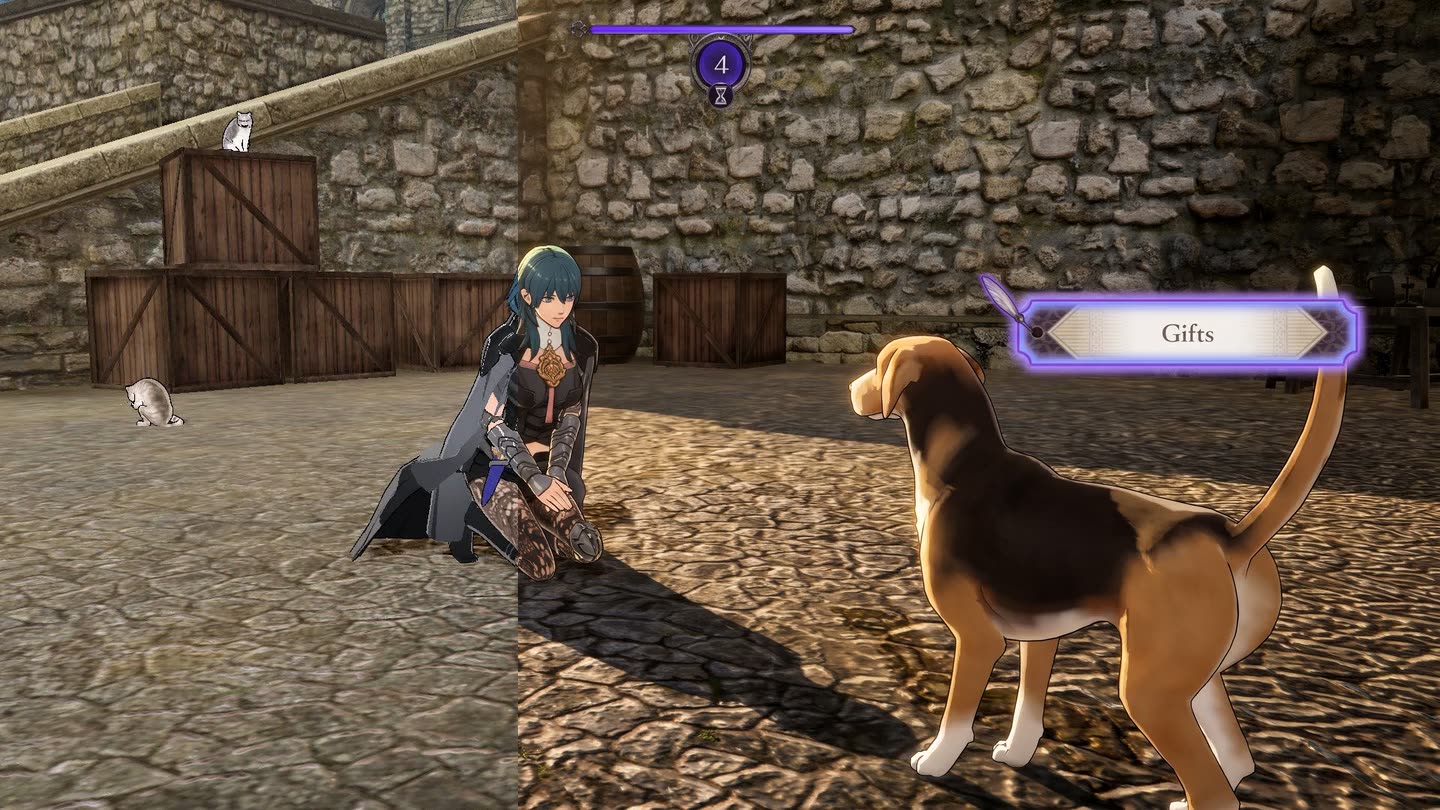 stock · via nxnativetarget · mockup
 stock · via nxnativetarget · mockup
Two things stay put on purpose: faces and UI. Texture work sorts each texture by what it is (UI, an anime face, stone, sky) before it touches anything, and faces and UI are never repainted. The pixel diff is there to prove the UI didn’t move.
Phase 1: the pieces
Phase 1 ran as five tracks at once, each in its own branch, each with its own tests. None of them commit a game file.
Map every shader. FE3H has 1,372 shaders. Each one now has a role: shadow depth, world, characters, sky and fog, the last pass before the UI, and the UI itself. That’s what lets a rule say “every world shader” instead of naming files, and it turned up three facts the plan depends on. The shadow map’s size is a single value in the game’s code. The shadow shaders read their resolution from an input instead of assuming 1024, so raising it is safe. And the world’s G-buffer already stores gloss and metalness, but the characters’ doesn’t, so characters get a better cel shader (rim light, warmer shadows), not a physically based one.
Lighting, written once. The upgrades are standalone Metal modules: AgX tonemapping, GTAO contact shadows, the character shader and a physically based pass for the world. Patchers wire them into the game’s shaders through the depth, normal and roughness inputs, and fall back to doing nothing if an input isn’t there. All 249 patched shaders compile clean.
Hooks in nxnative. Three small, opt-in additions in my nxnative fork:
- the scene’s depth, handed to every pass that needs it
- every texture dumped under a hash of its contents, and swapped at runtime for a replacement with the same hash
- a switch for a bigger memory pool
Sharper texture filtering (16× AF) was already there, so I didn’t rebuild it.
A texture factory on the Mac. It sorts each dumped texture by what it is (stone, wood, a face, UI) with a vision model running locally, and leaves faces and UI alone. It upscales the rest and generates normal and roughness maps, using a depth model (Depth Anything V2) for the relief in stone and brick. Then it packs them in exactly the format the runtime swap expects. Nothing leaves the machine.
A critic that can say no. Every change gets the same frame, stock and new, and a deterministic check. The UI may not move at all. Shadows may not crush to black, highlights may not clip, brightness may not drift, and the image may not get softer. It writes heatmaps of what changed. A vision model can score the result too, but only as advice: the pixel rules decide.
4K, from the inside
Upscaling makes a 1080p image bigger at the very end. I wanted the game itself to render at 3840x2160: its own render targets, viewports and swap chain. That took six patches in four places in the game’s code: its dynamic-resolution table, a render target setup that hard-codes 1920x1080, the display size, and the swap chain’s starting size.
The 3D scenes behind the title screen rendered full-frame at 4K right away. Then the game crashed every time it left the title screen, in the loader for its 3D models, and never without the patch. The loader wasn’t the problem. Its vertex buffers come from two fixed GPU memory pools the game sets up at boot (310 MB and 1,544 MB). At 4K every render target is four times the size, both pools ran dry, and the game never checks for a failed allocation.
The pools can’t simply grow, because they’re carved out of a fixed main heap, which is carved out of a fixed memory region. So the fix is four linked patches: pool A +256 MB, pool B +1 GB, and the heap and its region +1.25 GB to hold them, plus a host that offers the game more memory. With that, it gets past the title, through the menu and onto the save list with no failed allocations. At the peak, pool A is using 361 of its 566 MB and pool B 1,637 of its 2,568. Movies and the title layout still draw into the top-left quarter; that’s being fixed now, along with the same patches for 1440p and 1800p.
What’s next
- A real save at 4K. Load the monastery in 3D and capture 1080p against 4K with 16× AF: the first real comparison to replace a mockup.
- Put the pieces together. The patched shaders, the texture swaps and the critic, running on one live save instead of in their own branches.
- Unlock shadow map resolution, then AgX before the UI and GTAO, with the critic proving the UI never moved.
Two things in nxnative would make the loop much faster. Frame capture refuses FE3H today, because the game submits work on two queues. With it, a shader edit could be checked against one fixed frame in seconds, without running the game at all. The other is frame numbers in the control log, so a route through the game can be replayed frame for frame.
FE3H is first because I want to play it again, and because its art deserves a better renderer. Nothing in the approach is specific to it, though. Most Switch games sit on a handful of engines, so one engine adapter carries a whole shelf of games. The one I want next is the new Fire Emblem, Fortune’s Weave.